During the research and planning phase of this project, I put some thought into conventions and representations, specifically those of our genre.
Representations——————————————
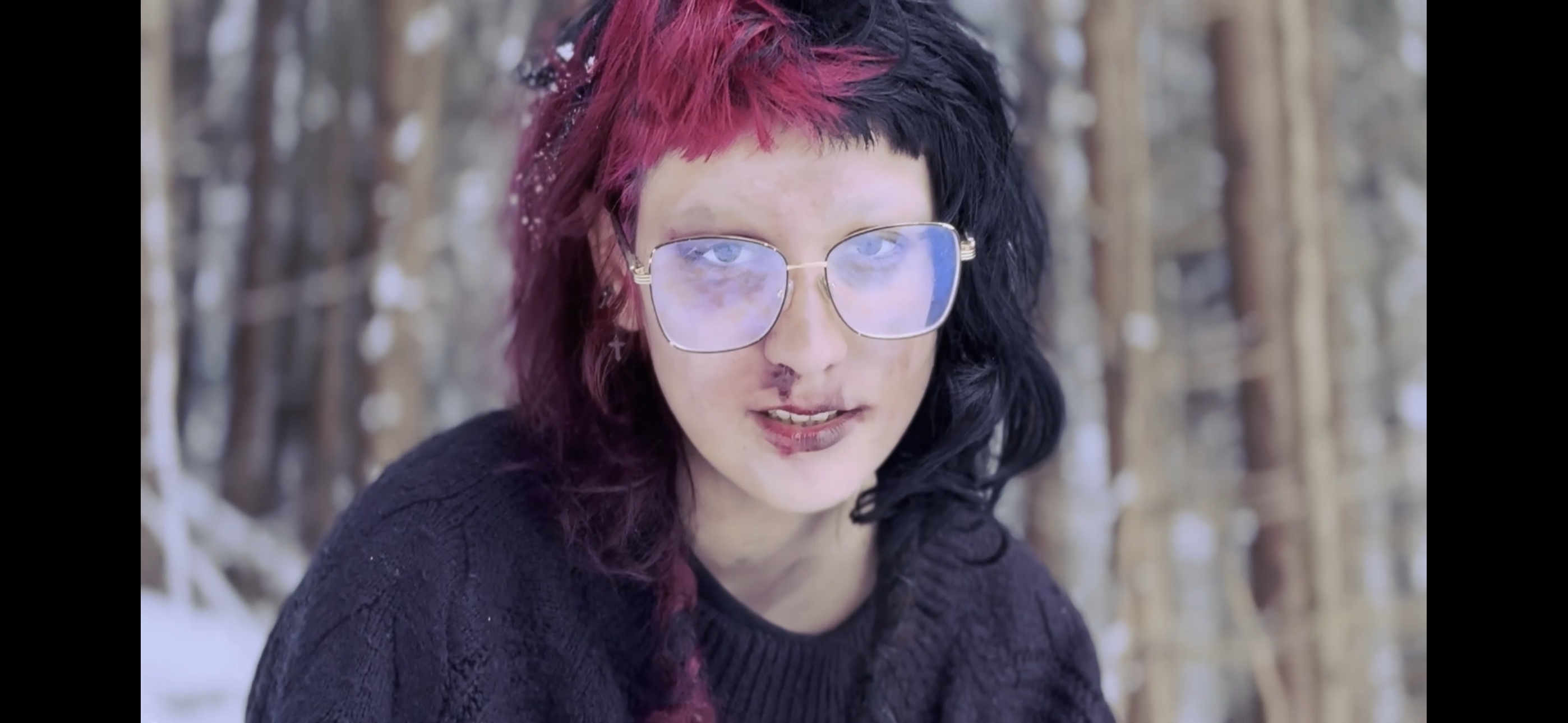
From the Characters post: Nemor subverses misogynistic stereotypes, by portraying a complex lead female character, and an equally complex female-presenting “villain” (the forest entity), neither of which are portrayed in a sexualised manner. The protagonist is not illustrated as a “damsel in distress”, while she runs from the horrors, it is framed as a general measure for survival and reaction to fear, she would not react much differently if she was male.
For that post, I researched Stuart Hall’s representation theories and Liesbet van Zoonen’s feminist theory. But how do the characters end up being represented in the final film opening?
Through careful character writing, we managed to portray the characters somewhat accurately to the way we planned them. Though, our character still ended up playing into a few stereotypes, such as the fact that she is portrayed as naive, which is a common way young women are shown in media. This trait is most prevalent in the scenes where her “past self” is gambling away her fate with The Entity, taking increasingly more and more aggression while still believing that there is a chance she can change the results. The film opening also starts out with her cleaning dolls, and both the act of cleaning and the dolls are associated with stereotypes of women. Furthermore, the protagonist did end up being a sort of “damsel in distress” which is stereotypical to women in film, however this is balanced out by the fact that the person in power is also female-presenting.
Traditionally, people who struggle with gambling addictions in media are middle-aged men, who are unemployed, isolated and struggling financially, and very rarely escape those conditions. In Nemor, the girl lives in a nice house, showing that she has escaped those conditions. However, she is shown to have compulsive behaviour. Nemor’s opening subverses most of the traditional stereotypes of what a gambler is supposed to look like.
In conclusion, Nemor subverting popular stereotypes of both women and people struggling with a gambling addiction helps fight harmful assumptions, expand representation and avoid flat, predictable characters.
Conventions———————————————
From the Film Genre post:
Paranormal horror is a horror subgenre that involves supernatural forces that seep their way into the real world. It separates itself from traditional horror by focusing on unexplained phenomena, and the fear it creates inside the audience and the characters, rather than physical effects.
Nemor will follow the Psychological Horror structure. In this structure, the line between reality and fantasy is blurred, the “horror” is more about the slow mental decay/breakdown of the character(s). This route often leaves the audience questioning whether the “horrors” were actually real, or just a product of the protagonist’s mind. This structure generally features an unreliable narrator.
Nemor is set in the woods. We picked this location because forests can have a natural scary aspect to them, a vast unknown landscape full of unseen predators, harsh conditions and no sign of civilisation, contrasting the familiar homely feeling of the bedroom at the very beginning of the clip. We plan to film in the winter, to benefit from the eerie snowfall in the mountains, and the cold, bare trees to accentuate our film’s unnerving atmosphere.
For that post, I researched the Paranormal Horror genre, as well as Steve Neale’s genre theory. But which conventions does the final film opening contain?
Nemor follows numerous paranormal horror genre conventions. Notably, the presence of a supernatural entity is a very common trope used in this genre of films. Psychological horror is also a common sub-theme of the genre, which is definitely something explored by our film opening. Rituals and spells are, again, common tropes, which Nemor portrays through the ‘card games’.
Our media product uses these conventions as structural tools, to help build a plot, an atmosphere and establish genre identity. Genre conventions are also a tool to build an audience, by creating audience familiarity. People who enjoy one film in the paranormal horror genre are likely to enjoy multiple, as they have familiar ‘enjoyed’ elements. Many of the conventions also have roots in cultural beliefs, this can allow a story to tap into collective fears or ideals, making them resonate more deeply with the audience.
Overall, due of these reasons, I consider Nemor following the genre conventions to be a positive trait of the film opening.
One thing I wish I would have done differently is the way the protagonist is introduced. While I appreciate “keeping the mystery”, I wish we would have revealed a bit more information about the character, either through explicit means such as a very short ‘context’ scene, or throught more implicit, mise en scene elements such as props around her room and maybe in the snow in the forest.
